
Prime Student vs. Regular Prime: The Real Differences
Prime Student and regular Prime unlock the same core benefits. The differences come down to price, verification, and a four-year clock. Students ages 18–24 or enrolled in college get a 6-month free trial, then pay $7.49/month. Regular Prime runs $14.99/month or $139/year.
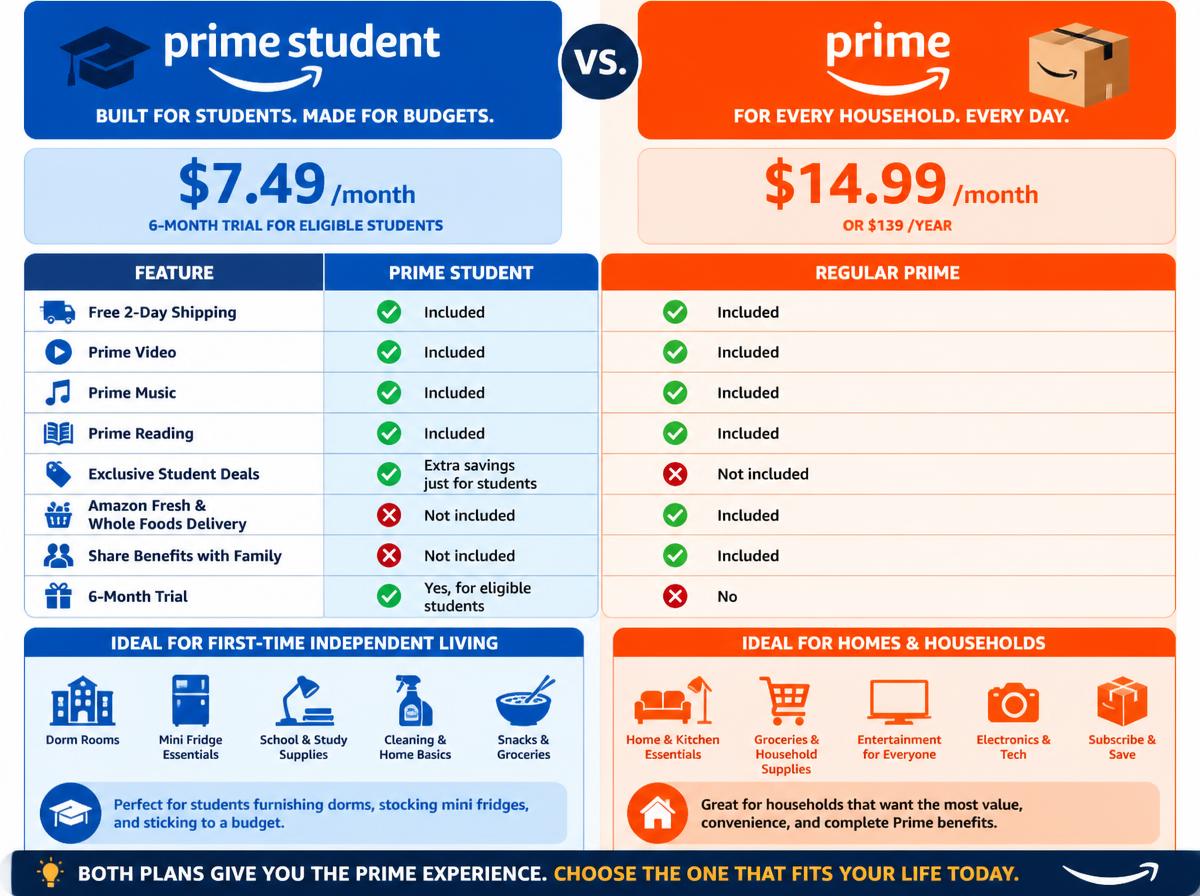
That’s the comparison in two sentences. What follows is the part that actually helps you decide: a full feature table, the real savings math, and the mistakes that cost students money.

Full Comparison Table
| Feature | Prime Student | Regular Prime |
|---|---|---|
| Monthly price | $7.49/month | $14.99/month |
| Annual price | Not offered (monthly only) | $139/year |
| Free trial | 6 months | 30 days |
| Eligibility | Ages 18–24 or enrolled student | Anyone |
| Verification required | Yes (enrollment proof) | No |
| Free fast shipping | Yes | Yes |
| Prime Video | Yes | Yes |
| Amazon Music | Yes | Yes |
| Prime Gaming | Yes | Yes |
| Exclusive deals | Yes | Yes |
| 5% cash back (Prime Store Card) | Yes | Yes |
| Household sharing | Yes (one other adult) | Yes (one other adult) |
| Max duration at discount | 4 years | N/A |
| Billing flexibility | Monthly only | Monthly or annual |
| Prescription savings (RxPass) | Yes | Yes |
| Prime Reading | Yes | Yes |
| Prime Try Before You Buy | Yes | Yes |
The table shows the real trade-off: you’re not losing features with Prime Student. You’re trading a verification step and a four-year clock for roughly half the monthly cost.
What You Actually Save
At $7.49/month, Prime Student costs about $89.88 per year. Regular Prime at $139/year costs $49.12 more. If you pay monthly for regular Prime, you’re spending $179.88 annually — nearly $90 more than the student rate.
That gap matters for a first apartment budget. According to a University of Cincinnati guide on packing for college, students should think through their budget and check what their residence hall already provides before buying anything. The same logic applies here: know what you’re paying for before you commit.
For a student furnishing a first apartment, that $50–$90 annual difference could cover a used desk, a set of pots and pans, or a couple months of renter’s insurance.
Eligibility: Who Qualifies
Prime Student is open to:
- Students ages 18–24 enrolled in at least one course at an accredited college or university
- Students of any age enrolled in college (verification still required)
You’ll need to verify with a valid .edu email address or upload enrollment documentation. Amazon checks this, and the verification isn’t instant in every case.
If you’re 18–24 but not enrolled, you don’t qualify. If you’re enrolled but over 24, you may still qualify — the age range is a guideline, not a hard cutoff, but Amazon’s verification system will ask for proof.
The Four-Year Clock
This is the part most students miss. Prime Student lasts up to four years or until you graduate, whichever comes first. After that, Amazon automatically moves you to regular Prime pricing unless you cancel.
That means if you start as a freshman, you’ll hit full price around senior year. Set a calendar reminder for your fourth year so you’re not surprised by a $14.99 charge.
If you graduate early or take a gap year, the clock still runs. Amazon doesn’t pause it.
What You Don’t Lose
A common assumption is that Prime Student is a stripped-down version. It isn’t. You get the same shipping speeds, the same Prime Video library, the same music catalog, and the same deal access.
Household sharing works the same way too. You can add another adult to your Prime Student account, and they get the shipping and video benefits. That’s useful if you’re splitting costs with a roommate.
The 5% cash back on Amazon purchases applies if you have the Prime Store Card — that’s a separate application, but the student membership doesn’t block it.
If you’re weighing whether the student rate is worth the verification hassle, remember it’s the same membership for roughly half the price — free fast shipping on textbooks and dorm gear, plus Prime Video and 5% cash back, all included. Start your 6-month free trial here.
When Regular Prime Makes More Sense
Prime Student isn’t automatically the right pick. Consider regular Prime if:
- You’re not enrolled and not 18–24. You don’t have a choice — regular Prime is the only option.
- You want the annual plan. Prime Student is monthly only. If you prefer paying once and forgetting it, regular Prime’s $139/year is simpler.
- You’re sharing with someone who isn’t a student. Household sharing works on both, but if the primary account holder isn’t a student, regular Prime avoids any verification questions.
- You’re past the four-year window. Once the student rate expires, you’re on regular pricing anyway.
Where the Answer Changes
The comparison above holds for most students, but the math shifts in a few specific situations. If you’re enrolled part-time at a community college, your school may not issue a .edu email — Amazon’s verification system accepts alternate documentation, but the approval window can stretch to several days, and during that gap you’re either paying full price or going without Prime. If you’re a graduate student over 24, your eligibility depends on whether Amazon’s verification partner flags your enrollment type; some graduate programs qualify, others get rejected on the first attempt and require a manual review.
If you’re an international student without a US-issued student ID, the documentation requirements differ again, and Amazon may ask for a transcript or enrollment letter instead of a standard ID. The takeaway: the price gap is real, but the path to unlocking it isn’t identical for every student. Verify your specific situation before assuming the student rate applies to you.
What This Means for Your Next Move
If you’re currently paying $14.99/month for regular Prime and you qualify for Prime Student, the practical answer is straightforward: switch. You’re leaving roughly $90 per year on the table for zero feature loss. The switch takes about ten minutes and requires one verification upload. If you’re not yet a Prime member and you’re starting college in the fall, sign up for the student trial before you buy dorm supplies — the free shipping on a single furniture order can cover the cost difference in one transaction.
If you’re a senior graduating in the next six months, don’t switch to student pricing now; you’ll hit the four-year cap almost immediately and get bumped back to full price. In that case, stay on regular Prime or cancel entirely until you know your post-graduation address. The decision isn’t “student vs. regular” in the abstract — it’s “how many months of student pricing will I actually use before the clock runs out.”
How to Verify Your Eligibility Before You Commit
Before you cancel your current membership or start a trial, confirm you actually qualify. Go to Amazon’s Prime Student signup page and enter your .edu email address. If Amazon recognizes the domain, you’ll get an instant verification prompt. If it doesn’t — which happens with smaller schools, some community colleges, and international institutions — you’ll be asked to upload a document showing your name, your school’s name, and your current enrollment term.
A screenshot of your class schedule works; a tuition bill works; a student ID works if it shows the current semester. The verification usually completes within 24–48 hours, but it can take longer during peak enrollment periods in August and January. Don’t cancel your existing Prime membership until the student verification clears. If you cancel first and verification stalls, you’ll lose free shipping on any orders you place during the gap.
What Can Go Wrong
The most common failure mode is assuming the student rate lasts as long as you’re enrolled. It doesn’t. The four-year cap is measured from your first student signup, not from your graduation date. If you took a gap year, studied abroad, or transferred schools, those months still count against the clock. A student who signs up freshman year, takes a semester off, and graduates in five years will hit full pricing before commencement. The second failure mode is household sharing. Prime Student allows one other adult, same as regular Prime, but if that adult tries to use their own Amazon account to access Prime Video, they’ll be blocked — sharing works through Amazon Household, not through password sharing.
If your roommate has been using your login, they’ll lose access when you switch to the student plan unless you formally add them to your household. The third issue is billing. Prime Student is monthly only. If you prefer annual billing to avoid monthly charges, you’ll need to stay on regular Prime and pay the higher rate. There’s no annual student option, and Amazon hasn’t announced plans to add one.
Common Mistakes to Avoid
Assuming you need a .edu email. You don’t. Amazon accepts enrollment documentation if you don’t have a school email address.
Forgetting to cancel after graduation. The rate jumps automatically. Mark your calendar.
Paying monthly for regular Prime when you qualify for student. That’s the most expensive path. If you’re eligible, verify and switch.
Thinking Prime Student lacks video or music. It doesn’t. The feature set is identical.
Signing up before checking your residence hall’s included services. Some dorms include streaming or shipping perks. Check first, then decide.
Decision Framework
Work through these questions in order:
1. Are you 18–24 or enrolled in college? If no, regular Prime is your only option. If yes, continue.
2. Can you verify enrollment? If yes, Prime Student saves you money. If no, you’ll pay regular pricing.
3. Will you still be a student in four years? If yes, the student rate covers you. If no, plan for the price jump.
4. Do you want annual billing? If yes, regular Prime is the only path. If monthly is fine, Prime Student wins on cost.
5. Are you sharing with a non-student? Both work, but regular Prime avoids verification friction.
If you answered yes to questions 1 and 2, Prime Student is almost always the better financial move. The features are the same; only the price and the clock differ.
FAQ
Can I switch from regular Prime to Prime Student?
Yes. Cancel your regular Prime and sign up for Prime Student with verification. You may lose any remaining time on your current billing cycle, so time the switch near your renewal date.
Does Prime Student include Prime Video?
Yes. The full Prime Video library is included, same as regular Prime.
What happens after four years?
Amazon moves you to regular Prime pricing automatically. You can cancel at that point or continue at the higher rate.
Can I share Prime Student with my roommate?
Yes. Household sharing works the same as regular Prime. You can add one other adult through Amazon Household.
Do I need a .edu email to verify?
No. Amazon accepts other enrollment documentation if you don’t have a school email address.
Is the 6-month free trial really free?
Yes, but it requires verification. After six months, you’re charged $7.49/month unless you cancel.
Does Prime Student include Amazon Music?
Yes. Amazon Music is included, same as regular Prime.
Can I get Prime Student if I’m over 24 but still enrolled?
Possibly. Amazon’s age range is a guideline, and enrollment verification may still qualify you. Check the current terms during signup.
The Short Version
Prime Student and regular Prime are the same membership. The differences are price ($7.49/month vs. $14.99/month or $139/year), the verification requirement, and the four-year limit. If you’re a student and can verify, the student rate saves you roughly $50–$90 per year with no feature loss. If you’re not a student, or you want annual billing, regular Prime is your path.
Check your eligibility, verify your enrollment, and set a reminder for the four-year mark. That’s the whole decision.