
Laundry Symbols Explained: What Every Tag Means
You’re staring at a tag inside your shirt and it looks like hieroglyphics. That little tub with dots, the triangle with a slash, the circle inside a square — each one tells you exactly how to wash, dry, bleach, and iron that item without ruining it. Here’s the quick breakdown: a washtub means washing, a triangle means bleach, a square means drying, and an iron means ironing. A slash through any symbol means “don’t do this.” One dot means gentle/low, two dots mean medium, and three dots mean high/hot.

The 5 Core Symbols You’ll See on Every Tag
Every laundry tag in the US follows the same basic system. Once you learn the five base shapes, you can decode almost any garment.
| Symbol | What It Means | What to Watch For |
|---|---|---|
| Washtub (with water lines) | Washing instructions | Dots = water temperature; hand inside = hand wash; X = do not wash |
| Triangle | Bleaching | Filled triangle = any bleach; diagonal lines = non-chlorine only; X = no bleach |
| Square | Drying | Circle inside = machine dry; arc line = line dry; flat line = dry flat; X = do not dry |
| Iron | Ironing/pressing | Dots = heat level; steam lines = steam allowed; X = do not iron |
| Circle | Professional care | Usually means dry clean; X = do not dry clean |
Common mistake: Most people ignore the difference between a plain square and a square with a circle inside. A plain square means “dry this flat or on a line.” A square with a circle means “you can put this in the dryer.” If you toss a plain-square item in the dryer, you’re gambling with shrinkage.

What You Need Before You Start
Before you sort a single load, grab two things: your phone and a permanent marker.
- Take a photo of every care tag on items you’re unsure about. You can zoom in later instead of squinting at a wrinkled tag in bad lighting.
- Mark your washer and dryer settings. Most machines have a delicate cycle and a low-heat dry option. Know where those dials or buttons are before you need them.
- Keep one cold-water detergent on hand. Cold water is the default for anything with a one-dot symbol, and most everyday items wash fine in it.
This prep takes about two minutes and prevents the most common mistake: guessing wrong because you couldn’t see the tag clearly.
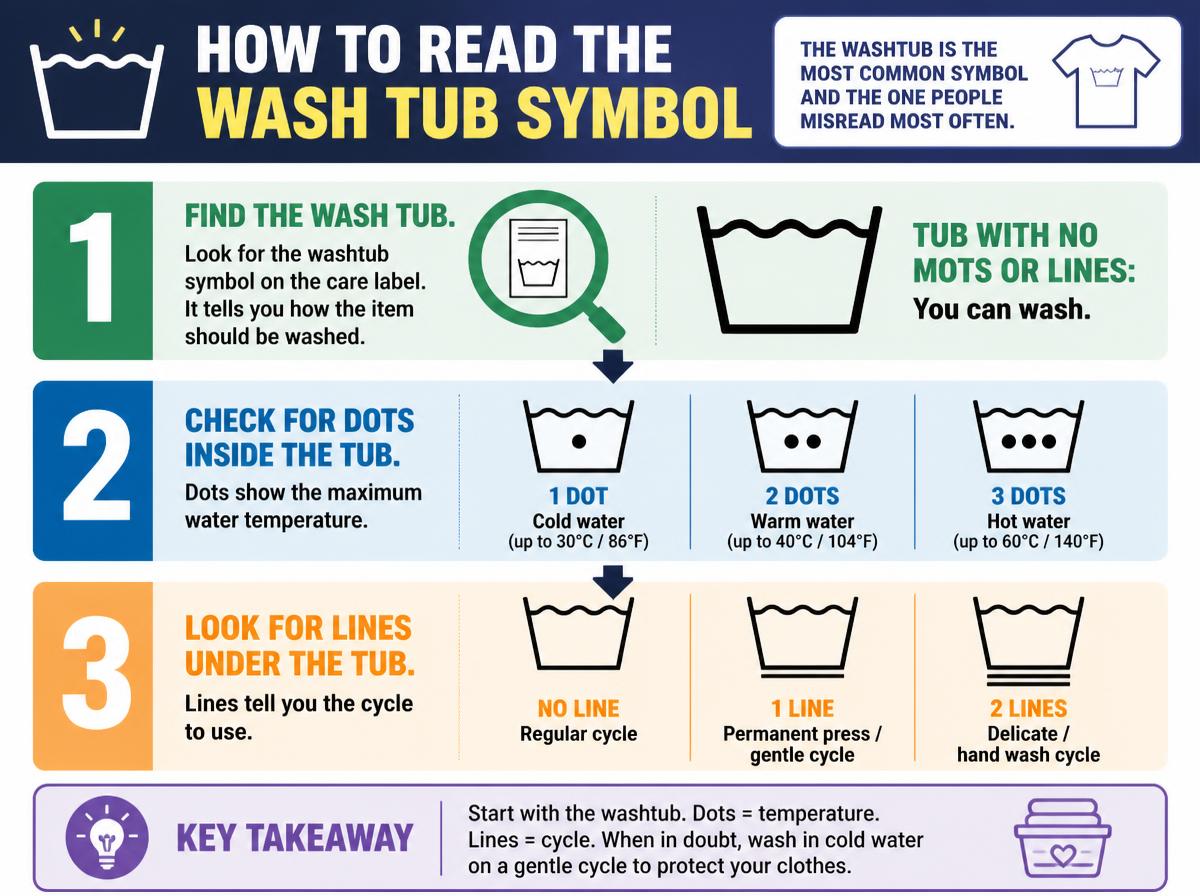
How to Read the Wash Tub Symbol
The washtub is the most common symbol and the one people misread most often. Here’s what the variations mean:
- Tub with no dots or lines: You can wash it any way you want.
- Tub with one dot: Cold water, gentle cycle (usually 85°F or below).
- Tub with two dots: Warm water, normal cycle (around 105°F).
- Tub with three dots: Hot water (around 120°F+). Reserved for sturdy cotton and whites.
- Tub with a hand reaching in: Hand wash only. Cold water, gentle squeezing, no machine agitation.
- Tub with an X through it: Do not wash. Take it to the dry cleaner.
- Tub with a number inside: That’s the maximum water temperature in degrees Celsius. 30 = cold, 40 = warm, 60 = hot.
Decision rule: If you see a hand symbol, don’t even think about the machine. If you see one dot, use cold water and the delicate cycle — even if the tag also says “cotton.” The dot overrides the fabric assumption.
Real-world example: A cotton t-shirt with one dot and a cotton t-shirt with three dots are not the same garment. The one-dot version likely has a special finish or dye that bleeds in warm water. Treat them differently even though both say “100% cotton.”
Stop and escalate: If a garment has a washtub with an X, do not wash it at home. That symbol means the item requires professional cleaning. Attempting to hand wash it anyway can ruin the fabric permanently — take it to a cleaner instead.
Bleach Symbols: The Triangle Explained
Bleach mistakes ruin more clothes than any other laundry error. The triangle is the only symbol that deals with bleach, and it has three states:
- Empty triangle: Any bleach is fine (chlorine or non-chlorine).
- Triangle with diagonal lines: Only non-chlorine (color-safe) bleach. Chlorine will damage the fabric.
- Triangle with an X: No bleach at all. Not even color-safe.
Common mistake: People assume “color-safe bleach” is always safe. The triangle with diagonal lines is the only symbol that permits non-chlorine bleach. If the triangle has an X, skip the bleach entirely — color-safe included.
Practical tip: When in doubt, test any bleach product on an inside seam before washing the whole garment. This works even if the tag is missing.
How to verify before you trust it: After testing bleach on an inside seam, wait 10 minutes and check for color change or fabric damage. If the test spot looks unchanged, the bleach is likely safe for that garment. If you see any fading or weakening, don’t use that product on the rest of the item.
Drying Symbols: Square + Circle Combinations
The square is the drying symbol, and it’s the most confusing because it has the most variations. Here’s the full breakdown:
| Symbol | Meaning |
|---|---|
| Square with circle inside | Machine dry allowed |
| Square with circle + one dot | Low heat |
| Square with circle + two dots | Medium heat |
| Square with circle + three dots | High heat |
| Square with circle + X | Do not tumble dry |
| Square with curved line at top | Hang to dry on a line |
| Square with flat line in middle | Dry flat (lay it out) |
| Square with three vertical lines | Drip dry (hang wet, no squeezing) |
| Empty square | Can dry any way |
Decision rule: If you see a square with a circle and one dot, use the lowest heat setting on your dryer. If you see a square with a flat line, lay the garment flat on a towel or drying rack — hanging it can stretch the fabric.
Real-world example: Most sweaters and knit dresses have the “dry flat” symbol. Hanging them on a hanger while wet stretches the shoulders and creates bumps. A flat drying rack costs about $15 and prevents this entirely.
Stop and escalate: If you pull a garment out of the dryer and it’s noticeably smaller than when it went in, stop drying it immediately. Lay it flat and gently stretch it back toward its original shape while it’s still damp. If it’s already dry and severely shrunk, that’s permanent — take it to a tailor to assess whether it can be let out, and check the tag next time before using heat.
How to verify your drying worked: After the cycle finishes, check the garment while it’s still slightly warm. It should feel dry to the touch with no damp spots in the seams, collar, or waistband. If any area feels cool or damp, run it through a short low-heat cycle again — don’t just hang it up, because trapped moisture causes mildew.
Ironing Symbols: Dots and Steam Lines
Ironing symbols are straightforward once you know the dot system:
- Iron with no dots: Any temperature, with or without steam.
- Iron with one dot: Low heat (synthetics like nylon and polyester).
- Iron with two dots: Medium heat (wool and blends).
- Iron with three dots: High heat (cotton and linen).
- Iron with an X: Do not iron. Use a steamer or hang in the bathroom during a hot shower.
- Iron with steam lines underneath: Steam is fine.
- Iron with steam lines crossed out: No steam. Use a dry iron or a pressing cloth.
Common mistake: Ironing synthetics on high heat melts the fabric. If you’re not sure what the fabric is, start with the lowest setting and test an inside seam.
Stop and escalate: If you smell burning plastic or see the fabric turning shiny or stiff while ironing, stop immediately. That’s the fibers melting. Unplug the iron, let the garment cool, and assess the damage. Melted synthetic fabric can’t be repaired — if the damage is visible, the garment is beyond saving.
How to verify your ironing worked: After ironing, hold the garment up to the light. Wrinkles should be gone, and there should be no shiny marks or scorch spots on the fabric. If you see a shiny patch, you used too much heat — use a pressing cloth next time or lower the setting.
The Circle Symbol: Dry Cleaning and Professional Care
A plain circle means professional cleaning is required or recommended. The letters inside tell the professional what method to use:
- P: Perchloroethylene (standard dry cleaning solvent)
- F: Petroleum-based solvent only
- W: Wet cleaning (professional water-based cleaning)
- Circle with an X: Do not dry clean
Practical note: If you see a circle with a P, that’s the standard dry cleaner. You don’t need to know what the solvent is — just tell the cleaner “follow the tag.” If you see a circle with a W, the garment can be professionally wet-cleaned, which is often cheaper than dry cleaning.
Budget tip: If the tag says “dry clean only” but the fabric is cotton or polyester, you can often hand wash in cold water and lay flat to dry. This is a judgment call — silk, wool, and structured garments (blazers, suits) should go to the cleaner. Test a small area first.
Stop and escalate: If a garment has a circle symbol with an X, do not attempt any at-home cleaning method. That symbol means the item cannot be professionally cleaned either — spot clean only with a damp cloth, and take it to a specialist if it needs more.
What to Do When the Tag Is Missing
Tags get cut out because they itch. Here’s how to handle it:
1. Check the fabric content on the care tag or the brand’s website.
2. When in doubt, use cold water and low heat. Cold water and low heat are the safest defaults for any fabric.
3. Wash like colors together — dark with dark, light with light — to prevent dye transfer.
4. If the fabric is delicate (silk, lace, cashmere), hand wash or dry clean. Don’t gamble with the machine.
Decision rule: When you don’t know, choose the gentlest option. Cold water, gentle cycle, low heat dry, no bleach. The worst case is the garment comes out slightly less clean — the alternative is ruined fabric.
How to verify your default method worked: After the first wash, check the garment while it’s still damp. The color should look uniform with no light or dark patches, and the fabric should feel the same as before washing. If the item came out misshapen or faded, adjust your method next time — colder water, no dryer, or hand wash.
Common Laundry Symbol Mistakes
- Ignoring the hand-wash symbol. Hand wash doesn’t mean “gentle cycle.” It means you physically wash it in a sink or basin with cold water and mild detergent.
- Using hot water on one-dot items. One dot is cold. Always. Hot water on a one-dot item causes shrinkage and color bleed.
- Tumble drying “dry flat” items. The flat-line square means the dryer will damage the fabric’s shape. Knits and sweaters are the usual victims.
- Bleaching anything with a triangle X. Even a small amount of color-safe bleach can strip dye from some fabrics.
- Assuming “dry clean only” is a suggestion. Some garments are constructed with water-soluble adhesives or sizing that dissolves in water. Washing them ruins the structure permanently.
FAQ
What does the circle inside the square mean?
It means the garment can be machine dried. A square without a circle means you should line dry or dry flat instead.
What does one dot on a laundry symbol mean?
One dot means the lowest setting — cold water for washing, low heat for drying or ironing.
Can I use color-safe bleach if the triangle has an X?
No. The X means no bleach of any kind, including non-chlorine formulas.
What does the hand in the washtub mean?
Hand wash only. Use cold water and a gentle detergent, and don’t wring or twist the fabric.
How do I know what temperature to use if there are no dots?
No dots means any temperature is safe. Use your best judgment based on fabric type and color.
What does the circle with a P mean?
It means the garment should be professionally dry cleaned using standard solvent. Tell your cleaner to follow the tag.
What should I do if I already shrunk a sweater?
Stop drying it immediately and lay it flat. While it’s still damp, gently stretch it back toward its original shape. If it’s already dry, the shrinkage is permanent — check the tag next time before using heat.
Learning to read laundry symbols takes about five minutes and saves you from shrinking your favorite sweater or bleaching a dark shirt. The system is consistent across every brand sold in the US, so once you know the five base shapes, you can decode any tag you come across. When you’re unsure, default to cold water, low heat, and no bleach — that combination is safe for almost everything you own.
<!– cluster-navigation –>
Explore This Topic
- Back to Laundry basics for beginners
Related guides in this cluster: