
Dorm Room Essentials on a Budget: Full Setup Under $200
Moving into your first dorm room is expensive. Between tuition, housing, and meal plans, the last thing you need is another $500 shopping list. The good news: you can build a fully functional dorm setup for under $200 if you know what to buy, what to skip, and what your school already provides.
Before you buy anything, check your residence hall’s website or email your RA. Most dorms include a bed frame, mattress, desk, chair, dresser, closet space, and trash can. Some even provide a mini-fridge and microwave. According to the University of Cincinnati’s move-in guidance, checking what your residence hall provides before you pack is the single biggest money-saver—you might already have half the items on your list.
One important boundary before you start shopping: this $200 plan assumes you already own basic bedding (sheets and a pillowcase), toiletries, a laptop, and a phone charger. If you’re starting from zero on any of those, add $50–75 to your total. The plan also assumes your dorm provides a bed, desk, and chair—which is standard at nearly all US colleges, but verify with your specific housing contract before you assume.
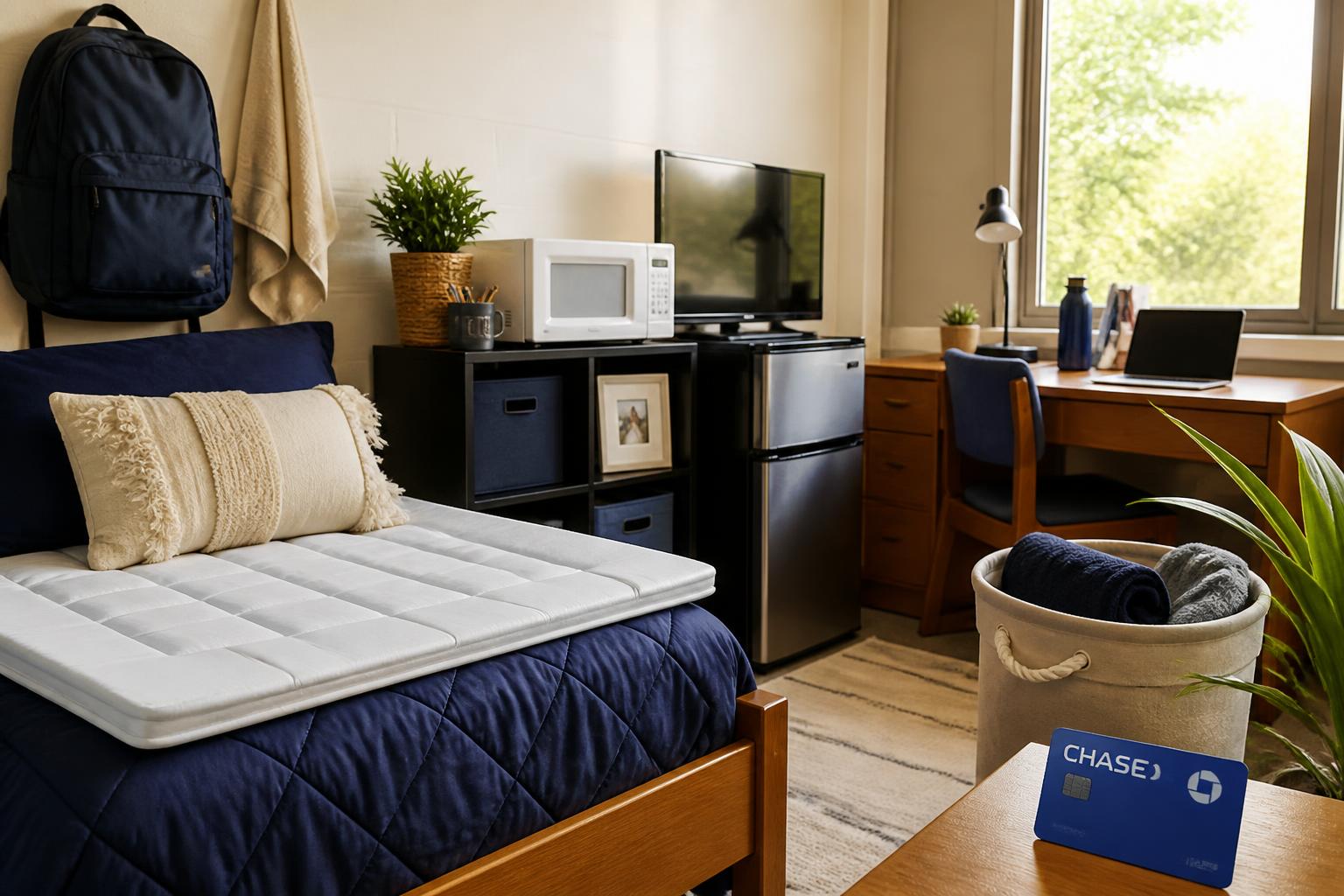
Where Your $200 Goes: Priority Tiers
Your spending should break down into four priority tiers. If your budget is tight, work down the list in order.
| Priority | Category | Budget Range | Why It Matters |
|---|---|---|---|
| 1 | Sleep | $40–60 | You’ll spend 7–9 hours a night here. Bad sleep ruins your semester. |
| 2 | Hydration & Food | $30–40 | Dining hall hours don’t match your schedule. You need backup options. |
| 3 | Storage & Organization | $30–50 | Dorm rooms are small. Clutter creates stress fast. |
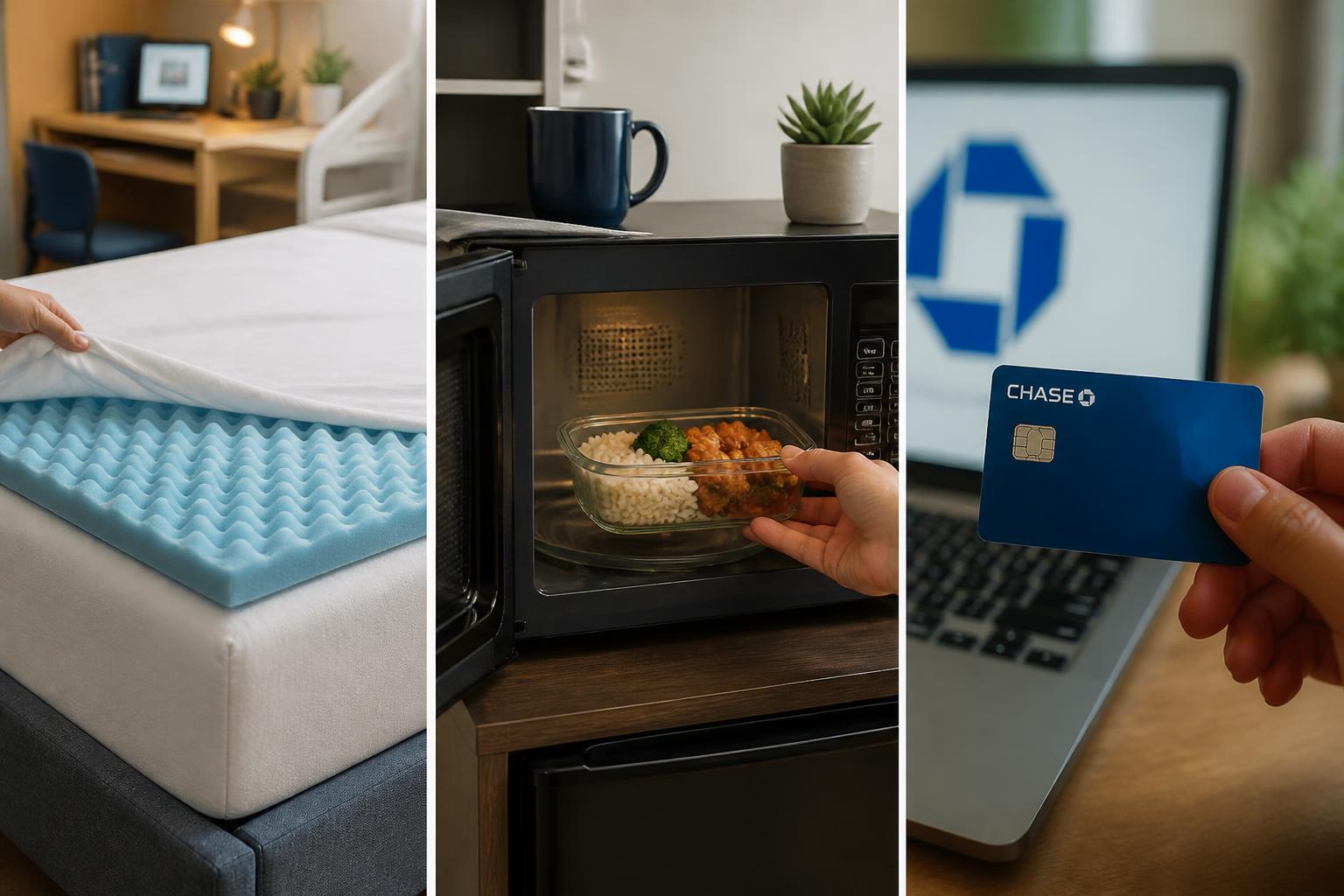
| 4 | Comfort & Convenience | $20–40 | Small upgrades that make a tiny room feel livable. |
|---|
Sleep Setup: The Highest-ROI Purchase You’ll Make
Your dorm mattress has hosted hundreds of people before you. That’s not a comforting thought, and it’s also not a comfortable surface. A mattress topper is the single best investment in this entire budget.
What to buy:
- Mattress topper (2–3 inch gel memory foam): $25–40. Gel-infused options sleep cooler than plain foam.
- Waterproof mattress protector: $10–15. Protects the topper and the dorm mattress. Some schools require one for damage deposits.
- Pillow: $10–15 if you don’t already own one.
Skip: New sheets if yours at home still fit. Standard twin sheets fit most dorm mattresses. Wait until you’ve seen the mattress in person—some schools use extra-long twin beds, and standard sheets won’t fit.
How to verify your mattress size before buying: Check your housing portal or residence hall FAQ for the exact bed dimensions. Most dorms list “twin” or “twin XL” in the room details. If you can’t find it online, email your RA or the housing office directly. A twin XL mattress is 5 inches longer than a standard twin, and standard twin sheets will pull off the corners within a week. This is the most common fit failure in dorm setups, and it’s completely avoidable with one email.
Food & Hydration: The Dining Hall Backup Plan
Dining halls close. They close early on weekends, during breaks, and when you’re sick and can’t leave your room. A small backup stash prevents late-night vending machine purchases that drain your budget.
What to buy:
- Brita Small 6 Cup Water Filter Pitcher, Metro Black ($15–25): Tap water in dorms can taste metallic or chlorinated. A filter pitcher pays for itself in about two weeks compared to buying bottled water. The 6-cup size fits in a mini-fridge door without hogging shelf space.
- Brita Small 6 Cup Water Filter Pitcher, Metro White ($15–25): Same capacity, different look. Choose whichever matches your room. The Elite filter version lasts longer between replacements.
- Microwave-safe bowl, mug, and utensils: $10 total from a discount store. You don’t need a full kitchen set.
- Non-perishable snacks: $15–20. Instant oatmeal, granola bars, popcorn, and ramen cover late-night hunger without a meal plan swipe.
Skip: A full cookware set, a toaster, or any appliance that your dorm’s fire code prohibits. Check your housing contract—many dorms ban open-coil appliances. The bella Fits-Anywhere 2-Slice Slim Toaster ($20–30) is a good pick if your dorm allows toasters, but confirm first. The slim design fits on crowded countertops, and the oatmilk color hides dust well.
The toaster trade-off you need to know: Even if your dorm allows toasters, consider whether you’ll actually use one. A toaster is a single-purpose appliance that takes up counter space and requires cleaning. If you’re only toasting bread a couple times a week, a $5 toaster oven from a thrift store or a stovetop pan works just as well. If you eat toast, bagels, or frozen waffles daily, the bella’s slim footprint and long slot justify the cost. Match the appliance to your actual eating habits, not the idea of them.
Money-saving rule: Buy your filter pitcher and toaster before you move in. Prices at campus bookstores run 30–50% higher than online.
Top Pick
The Brita Small 6 Cup Water Filter Pitcher, Metro Black is the strongest choice for most dorm rooms. The 6-cup capacity covers a full day of drinking water without monopolizing fridge space, and the BritaPlus filter reduces chlorine taste and odor right out of the box. If you prefer a lighter look or want the longer-lasting Elite filter, the Metro White version is the same pitcher with a different filter option.
Storage & Organization: Making a 12×12 Room Work
Dorm rooms are roughly the size of a parking space. Vertical storage is your friend.
What to buy:
- Over-the-door hooks (3–4 pack): $8–12. Hang jackets, bags, towels, and robes without taking up floor space.
- Under-bed storage bins (2–3 flat bins): $15–25. Store off-season clothes, extra bedding, and shoes. Look for bins with wheels—you’ll thank yourself at laundry time.
- Command hooks and strips: $10–15. Dorm walls are usually cinderblock or drywall with strict damage policies. Command products remove cleanly if you follow the instructions.
- Desk organizer: $8–15. A simple tray or caddy keeps pens, chargers, and notebooks from covering your entire desk.
Skip: A new desk chair unless yours is visibly broken. The standard dorm chair is uncomfortable, but you can add a cushion for $10 instead of spending $80–150 on an upgrade.
How to confirm your wall type before buying Command hooks: Look at the wall surface. If it’s painted cinderblock (common in older dorms), Command strips may not stick well—the rough surface reduces adhesion. If it’s drywall, Command products work as advertised. To test, press a small strip against the wall for 30 seconds and see if it holds after an hour. If it slides, you need removable adhesive putty instead, which costs $3–5 and works on cinderblock. This 60-second test saves you from buying $15 of hooks that fall off your wall in week one.
Comfort & Convenience: Small Upgrades, Big Impact
These items don’t seem essential until you need them.
What to buy:
- Power strip with surge protection: $15–20. Dorm outlets are scarce and often poorly placed. Get a strip with a 6-foot cord and USB ports. Check your housing contract—some dorms ban non-surge-protected strips.
- Small fan: $15–25. Dorm thermostats are controlled centrally. A clip-on fan for your bed frame works when the room runs hot.
- Laundry bag or basket: $8–15. A collapsible bag is easier to store than a rigid basket.
- Shower caddy and flip-flops: $10–15. If you’re using a communal bathroom, you need a caddy that fits your shower caddy’s dimensions and flip-flops for the shower floor.
Skip: A TV, a printer, and a coffee maker. Your laptop handles streaming, the library prints for free or cheap, and the campus coffee shop is closer than your room.
The power strip failure mode: Before you buy, count the outlets in your room and measure the distance from the desk to the nearest wall outlet. Many dorm rooms have outlets only on one wall, which means a 6-foot cord is the minimum—not a luxury. Also check whether your dorm’s outlets are the standard 3-prong type. Some older buildings still have 2-prong outlets, and a surge protector with a grounding plug won’t fit. If that’s your situation, you need a 2-prong adapter (about $5) or a power strip designed for ungrounded outlets.
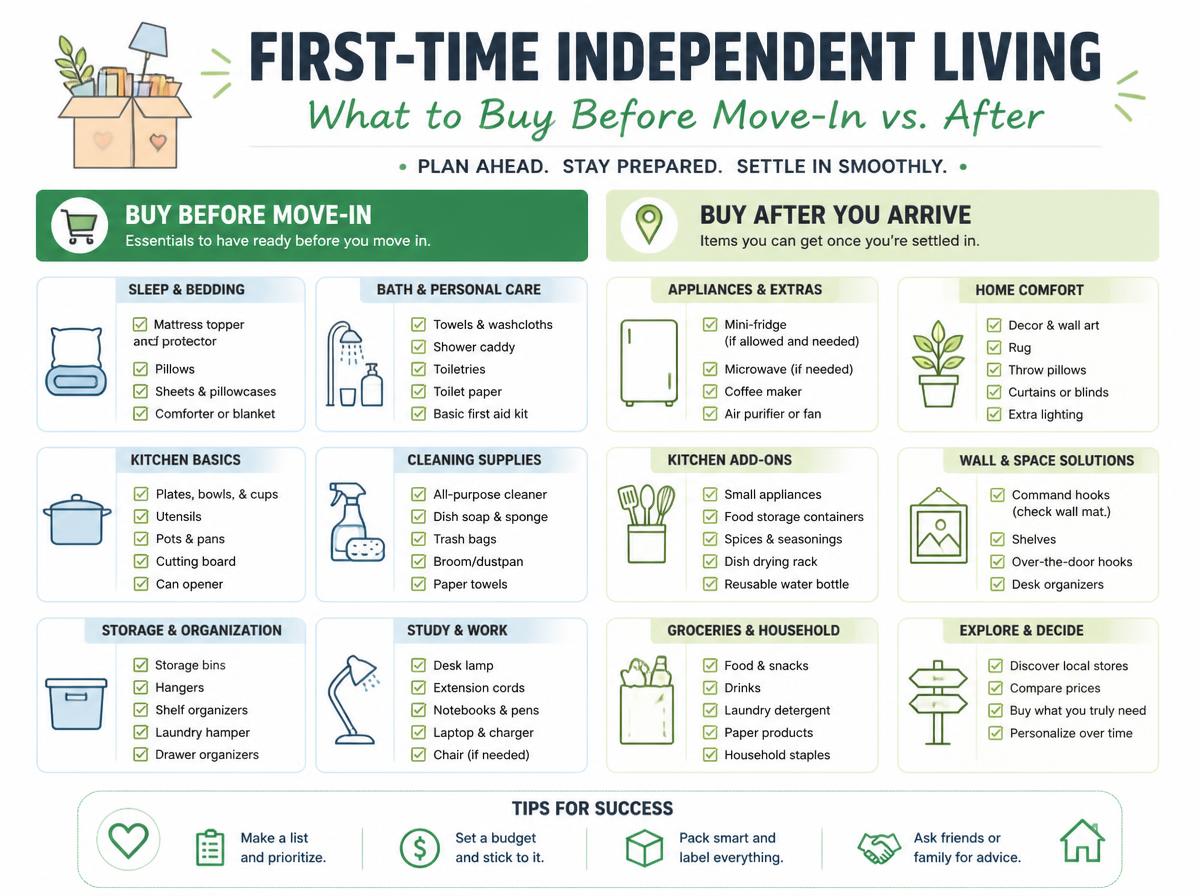
What to Buy Before Move-In vs. After
| Buy Before Move-In | Buy After You Arrive |
|---|---|
| Mattress topper and protector | Mini-fridge (if allowed and needed) |
| Filter pitcher | Command hooks (check wall material first) |
| Bedding and pillows | Extra storage bins (measure under your bed) |
| Power strip | Desk lamp (check desk layout) |
| Toiletries and shower gear | Area rug (measure the room) |
This split prevents two common mistakes: buying items your dorm already provides, and buying items that don’t fit your specific room.
Common Mistakes That Blow Your Budget
Mistake 1: Buying everything before checking the dorm rules.
Your housing contract lists prohibited items. A $40 toaster you can’t use is $40 wasted. Read the contract before you shop.
Mistake 2: Buying full-size versions of everything.
Dorm rooms lack storage. A 12-pack of paper towels and a jumbo shampoo bottle eat precious space. Buy travel-size or student-size versions until you know your storage situation.
Mistake 3: Ignoring the roommate conversation.
Coordinate with your roommate before buying shared items. You don’t need two filter pitchers, two mini-fridges, or two area rugs. Split the cost and share.
Mistake 4: Forgetting about move-in day logistics.
If you’re flying or shipping boxes, every item costs money to transport. A $10 purchase that costs $25 to ship isn’t a bargain.
The $200 Breakdown: One Way to Split It
Here’s a realistic allocation if you’re starting from zero:
| Item | Estimated Cost |
|---|---|
| Mattress topper | $35 |
| Mattress protector | $12 |
| Pillow | $12 |
| Brita 6-cup pitcher | $18 |
| Bowl, mug, utensils | $10 |
| Snacks | $15 |
| Over-door hooks | $10 |
| Under-bed bins (2) | $20 |
| Command hooks | $12 |
| Desk organizer | $10 |
| Power strip | $18 |
| Clip-on fan | $15 |
| Laundry bag | $10 |
| Shower caddy + flip-flops | $12 |
| Total | $199 |
Adjust based on what you already own and what your dorm provides.
If you’re 18–24 or an enrolled student, Amazon Prime gives you a 6-month free trial with free fast shipping on everything you just read about, plus Prime Video, Amazon Music, Prime Gaming, exclusive deals, and 5% cash back on Amazon purchases. That free shipping alone can save you $20–30 on this setup. Start your 6-month free trial here
FAQ
Can I really set up a dorm room for under $200?
Yes, if you already have basic bedding, toiletries, and a laptop. The $200 covers the essentials that make a dorm room livable: sleep upgrades, food backup, storage, and small comfort items. If you’re starting from zero with no bedding or toiletries, expect to spend closer to $300.
What should I absolutely not buy for my dorm?
Skip full cookware sets, printers, TVs, and coffee makers. Dorm rooms lack storage and your school provides alternatives. Also skip any appliance your housing contract prohibits—check the rules before buying.
Should I coordinate purchases with my roommate?
Yes. Shared items like a filter pitcher, mini-fridge, microwave, and area rug should be split between you. Coordinate before move-in to avoid duplicates.
Is a Brita pitcher worth it in a dorm?
Yes, if you drink water regularly. A filter pitcher costs roughly the same as 8–12 bottles of water and lasts months. The 6-cup size fits in most mini-fridges and the filter replacement schedule is printed on the packaging.
When should I buy my dorm essentials?
Buy bedding, sleep items, and toiletries before move-in. Buy storage, hooks, and space-dependent items after you see your room and measure your available space.
<!– cluster-navigation –>
Explore This Topic
- Back to Grocery shopping on a budget
Related guides in this cluster: